The Lowe Inquiry Publishes Its Report
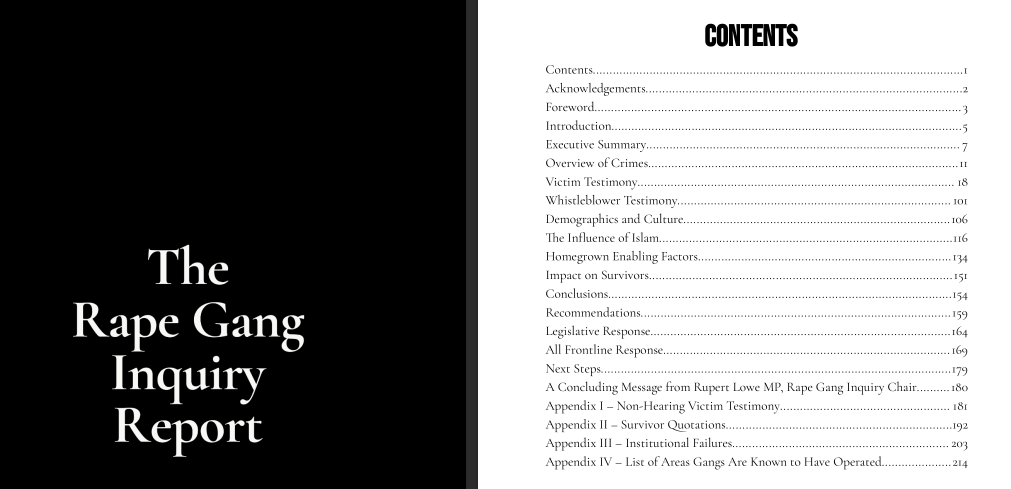
Rupert Lowe's crowdfunded inquiry publishes its 219-page report, drawing on testimony from survivors, whistleblowers and expert witnesses. Led by survivor Sammy Woodhouse, it documents allegations of organised sexual exploitation, institutional complicity and decades of official failure.
The report presents testimony and recommendations for public examination, but the inquiry has no statutory power to compel evidence.
National Grooming Gangs Inquiry
Baroness Anne Longfield chairs a three-year statutory inquiry under the Inquiries Act 2005, with powers to compel testimony and evidence. Following decades of failed investigations, it will examine institutional cover-ups and failures across England and Wales. It cannot establish criminal liability, which remains the responsibility of police and prosecutors.

The Lowe Inquiry Is Announced
Ex-Reform MP Rupert Lowe launches a crowdfunded inquiry into grooming gangs, raising more than £600,000 in public donations. The independent effort gathers survivor testimony and evidence but has no statutory powers to compel witnesses or documents.
Cummings: Officials Wanted "Total Cover-Up"
Dominic Cummings, Chief Adviser to Boris Johnson, described "multiple conspiracies" to cover up reports of child abuse by the Department of Education, and local councils, over two decades.
No names have been given, no prosecutions have happened, and the Establishment is unwilling and unable to hold itself to account.

Independent Commission on Grooming Gangs
The Home Secretary "accepted" Casey's recommendations, and announced a "fact-finding" commission with no criminal powers in which other people would investigate themselves.
Although it will have statutory powers under the Inquiries Act, it will only "coordinate local inquiries" rather than conduct a proper national investigation. It will not investigate national bodies or central institutions.
Casey Audit on Group-Based CSE
Baroness Louise Casey conducted a rapid national audit examining the nature, scale and characteristics of gang-based exploitation, specifically looking at ethnicity and cultural drivers. She said there had been institutional "obfuscation" instead of "examination."
Despite being the most thorough investigation yet, the audit had no statutory powers, limited evidence to work with, and could only provide "recommendations" rather than enforce accountability or prosecution.

Miah: Councillors Protected Offenders
Former government advisor and ex-counter terrorism officer Raja Miah, a Muslim Labour party member first spoke up about Islamic rape gangs in 1997, claiming councillors in Labour constituencies are involved in covering up crime for political gain.
Miah has been smeared and threatened by other Muslims for speaking out, whilst being on the end of a campaign to discredit his claims.
Home Office Report on Group-Based CSE
An "external reference group" of academics, law enforcement, victim advocates, and parliament workers produced a paper for the government obscuring the ethnic disparity in offending, which oddily reached the conclusions they were aiming for.
Described as a "lazy report" with "simple cut and paste" methodology. It appeared designed more to downplay uncomfortable truths than reveal them.

The Alexis Jay Report
Professor Alexis Jay's independent inquiry into child sexual exploitation in Rotherham, finding at least 1,400 children had been sexually abused between 1997 and 2013.
It was not a statutory inquiry and could only provide "recommendations". It led to resignations and hand-wringing, but no fundamental systemic change or criminal accountability for those who enabled the abuse.


Operation Hydrant
Established to coordinate investigations into historic child abuse involving institutions and prominent individuals, Hydrant recorded thousands of suspects and allegations. It did not investigate crimes itself. Reorganised as the Hydrant Programme in 2022, it later took responsibility for the national Child Sexual Exploitation Taskforce, established in 2023.
Hydrant coordinated national work and supported investigations; individual police forces remained responsible for investigating crimes.
Enough with the Reports
Thirty years of inquiries, reports, and recommendations. Thousands of pages of findings. Hundreds of recommendations ignored. Meanwhile, the abuse continues and justice remains elusive.
Britain finally has a statutory national inquiry. But an inquiry is not a prosecution, recommendations are not justice, and another round of apologies will not suffice. The test is whether offenders are convicted and those who concealed or enabled their crimes are finally held accountable.